How to wax skis at home without a bench or vise
Fresh wax is a cheap upgrade with a big payoff: better glide, easier turns, and a base that lasts longer. The thing that stops most skiers from waxing at home isn't the wax, it's the workspace. Shop benches and vises are bulky, expensive, and overkill for a hot wax. Here's how to wax your skis at home without a bench, using a setup that fits on a table or a garage floor. Stick around to the end and we'll cover edge tuning too.

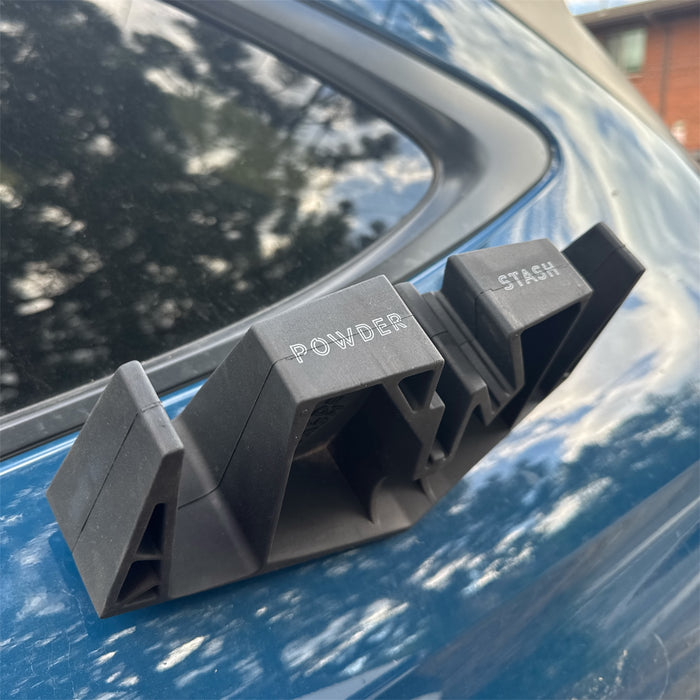
A couple of Powder Stashes supporting a ski while tuning the edges.
Why wax at home
A shop tune is worth it a few times a season, but a basic hot wax is a 30-minute job once you've done it twice. Waxing regularly keeps your base from drying out, and doing it yourself means you can wax the night before a storm day instead of dropping your skis off for 48 hours. It works the same for snowboards.
What you'll need
- Wax iron (or a dedicated old clothes iron, never one you'll use on clothes again)
- All-temperature wax (Swix or Mountain Flow work well)
- Plastic scraper
- Nylon brush
- Brass brush
- Thick rubber bands to hold the ski brakes up
- Base cleaner or a rag and citrus cleaner
- Two stable supports to rest the ski on
- For edges: a side edge bevel guide with file, and a diamond or gummy stone
The no-bench setup
All you're replacing from a shop bench is a stable, grippy platform at two points: one under the tip area, one under the tail area. Three ways to get there:
1. Two Powder Stash® units. A pair of Powder Stash holders set on a table or garage floor makes a stable, portable tuning stand. The rubber grips the ski so it doesn't slide while you scrape, and each unit has two tuning slots: a vertical 90 degree slot and an angled 45 degree slot. Base-up across the top for waxing, on edge in the slots for filing. When you're done, the same two units go back to work as car-side holders and in-car storage. A tuning stand for less than a tuning stand.
2. Sawhorses or a folding table with padding. Works fine if you already own them. Add rubber shelf liner at the contact points so the ski doesn't skate around, and expect wax drips on whatever's underneath. For edge work you'll need a helper to steady the ski, or a vise.
3. DIY wood blocks or text books. Two 4x4 offcuts with foam or rubber glued on top cost almost nothing. The trade-off is stability: unweighted blocks slide during scraping, which is the highest-force step. Books can act the part in a pinch, but slide around a lot.
Snowboards work with the same setups. The wider platform actually makes them easier to balance.
Step by step: the hot wax
- Retract the brakes. Loop a thick rubber band over one brake arm, stretch it over the heel piece, and hook the other arm so the brakes sit above the base. Snowboarders, skip this step.
- Clean the base. Wipe off dirt and old wax with base cleaner, a nylon, or wire brush and let it dry. If the base looks white or chalky, it's thirsty, and this wax will make a visible difference.
- Drip or crayon the wax. Hold the wax bar against the iron and drip a line down each side of the base, or rub the bar directly on the base for thinner coverage.
- Iron it in. Keep the iron moving tip to tail in slow, steady passes. The wax should melt into a trailing wet sheen behind the iron. If the wax smokes, the iron is too hot.
- Let it cool. Give it 20 to 30 minutes at room temperature so the wax sets in the base, not on top of it.
- Scrape. Hold the plastic scraper at about 45 degrees and push tip to tail with firm, overlapping strokes until you stop pulling up ribbons of wax. This is where a grippy stand earns its keep.
- Brush. Finish with firm tip-to-tail passes with the nylon brush to open up the base structure. More brushing means more glide.
Tuning your edges
Sharp edges are what hold you on firm snow, and they dull faster than most people think. The catch with edge work is that the ski has to sit on edge and stay put while you file. That's what the tuning slots on the Powder Stash are for: drop the ski into the vertical 90 degree slot to hold it upright for side edge work, or use the angled 45 degree slot when you want the ski tilted for a more comfortable filing angle. The rubber keeps the ski steady without marking the topsheet.
- Set the ski on edge. Slot it into the 90 degree slot with the edge you're working on facing up.
- Deburr first. Run a diamond or gummy stone lightly along the edge to knock down burrs and rust spots from rocks and rails.
- File the side edge. Set your bevel guide (88 degrees is a common all-mountain angle, but match whatever your skis were tuned to), and pull it tip to tail in smooth, overlapping strokes. Let the file cut on the pull, don't force it.
- Polish. Finish with a few light passes of the diamond stone in the same guide for a cleaner, longer-lasting edge.
- Detune if you like. A few light stone passes on the edges at the very tip and tail contact points makes skis feel less hooky. Park riders often detune more; racers don't.
Work in a spot with decent light, and wipe the edge with a rag when you're done. Filings on a wax-fresh base undo your work.
How often should you wax?
A common rule of thumb is every 4 to 6 ski days, more often in spring snow or man-made snow, which are both abrasive. The base will tell you: white, dry-looking edges of the base mean it's overdue. Edges just need a quick stone pass whenever they feel dull or you can see burrs.
Common questions
Do I need a vise? Not for this. Two grippy supports handle waxing, scraping, and brushing, and the 45 and 90 degree slots hold the ski on edge for filing. A full race tune with heavy base grinding is still a shop job.
What iron temperature? Follow the wax packaging. The wax should melt on contact without smoking.
Can I use one all-temp wax for everything? For most recreational skiing, yes. Temperature-specific waxes are a racing-level optimization.
Set up once, tune all season
The Powder Stash 2-pack covers the stand side of this whole guide: a stable waxing platform, 45 and 90 degree slots for edge work, plus a magnetic ski and snowboard holder for the parking lot and organized storage inside your car. Free shipping, 30-day money-back guarantee, designed and tested in Colorado.